Monday, May 20, 2013

Know Yr (American) Cacti

To learn about the cactus..you must become one with the cactus !

We all know what cactus is right? I'm going to assume at least that much. The plural of CACTUS is CACTI, because it's cool sounding Latin and that's just how the rules of the language are, and 'cactuses' sounds dumber. Here is a little primer on more specific types of cactus, since there are so many types out there...

There are two MAJOR types of cacti we will discuss here, which further filter into subtypes etc. These two are OPUNTIA and CEREUS. Opuntia is pronounced 'oh punch ya' as in "oh I'll punch ya real good if you keep runnin' yer mouth like that!" Cereus is pronounced like 'serious' like "why so serious?" (the Joker's famous line).

The main way to distinguish these two is OPUNTIA cacti have hairy warts (gross) and usually jointed limbs. CEREUS have SMOOTH warts. That's the truth to bear, warts and all!

So let's start with OPUNTIA cacti. These are further divided into two types, PRICKLY PEARS and CHOLLAS (pron. 'choy-as'...not to be confused with cholos).

Prickly pear cacti come in many varieties even further still. They tend to have round ball or flat plate shaped links and oval-ish rounded (usually reddish) fruit growing straight out from the links. Observe:

 Not too hard to recognize eh? Here's some further ID:
 During blooming time, the blossoms are usually yellow (though sometimes red, purple etc.) Prickly Pear cacti are native to every U.S. State except Maine Vermont and New Hampshire.

The fruit looks like this when cut open:

BTW the fruit as you see it on the screen is pretty much exactly lifesize (like a small fist size), UNLESS you are reading this on a mobile phone or something. And yes the fruit is as grainy and mushy as it looks. Those black seeds are round and VERY hard and stony. Sometimes the fruit is yellow on the inside too, important note. To gather the fruit it just kinda snaps off the cactus BUT be wary of the spines. They aren't giant barbed things or anything like on the cactus itself. The fruit spines are these tiny little hair splintery slivery bastard things that can easily lodge in your skin and make you itch and all other forms of unpleasantries. Not deadly, but it's annoying.

 So wear thick gloves or VERY deftly pick without touching the spines. My grandfather had a cool improvised harvesting tool for this, a simple pole with a soup can (or whatever can) attached to the end. That way you can reach higher spots on the taller cacti as well. You put the can around the fruit and give a little twist motion and PLUNK! the fruit falls in the can. Then you can put it in a gathering basket or whatnot.

To cut open fruit hold at the very ends (which are pretty much spine free) and cut a shallow slit down the side. Cut another slit on the other side and kinda carefully peel the skin away. OH and don't eat too many of these you might get constipated or somethin'. They are tasty and healthy in reasonable doses though.

Ok, so to re-cap, the two BIG BIG main categories of cacti we're talking about here are Opuntia and Cereus. Within the Opuntia realm (we'll get 'Cereus' later)  it is sub divided into Prickly Pears and Chollas. So we just talked about the Prickly Pears, here are the Chollas (drumroll)..


Chollas tend to have sausage links and gross fruit. They are found in the Cactus Belt and thin out northward in Nevada, Utah, Colorado, Oklahoma and Kansas. The blossoms are almost every color, usu. yellow or red though. There are different sub-kinds of chollas. Here are some examples:

The 'Chain Fruit' of Fulgida Cholla can grow 12 ft high and spread 12 ft. Fruit grows off of fruit until a whole cluster falls. Is the fruit edible??? It's gross anyway so I won't bother with that.


The 'Jumping Cactus' Cholla you barely brush against, and a cone will loosen and stick to you and will have appeared to have jumped from nowhere.
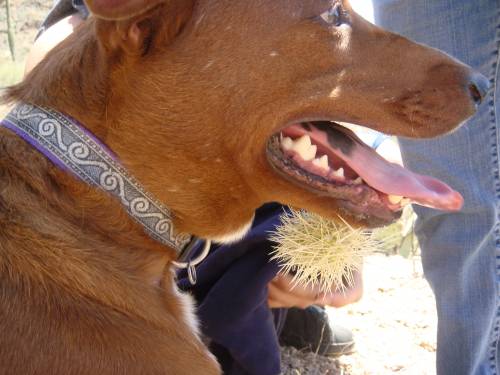
This poor bloke got himself a cactus beard prolly as a result of a goddamned jumping cactus. Here's a full plant view:


What other kinds of Chollas are there? There's the 'Teddy Bear' Cholla. It's about the most prickly cactus EVER. It has 1000's of needles encased in a white tissue sheath to create a 'down' or 'stuffing' effect. Maybe that's where the teddy bear part comes in. Still, I wouldn't hug this sucker for comfort. It's about shoulder high with a wrist sized trunk and a mess of chain links on top. This cactus is actually the one 4 photos earlier used to introduce the Cholla family (with the sun shining through in shadowy silhouette mode.)

There's also a Cholla called the 'Staghorn', and you can pretty much see how it got its name:

When the Staghorn dies it leaves a skeleton with holes in it (see the one on the right):


I believe there are other kinds of Chollas out there, but this will suffice for now. So now we've pretty much gone over the whole OPUNTIA family of cacti. Let's move on to CEREUS.

Cereus has the most subtypes for sure. There's Saguaro, Organ Pipe (Pitahaya), Old Man (Senita), Night Blooming, Barrel (Bisnaya), Hedgehog, Pineapple, Pincushion and more.

Saguaro is almost the most recognizable cactus out there:


It can live several 100 years and grow HUGE! The skeletons are like reinforced concrete!
The Native Americans used the skeletons to build shelter, for fishing poles, for poles to knock fruit from high places, and so forth. There are white nightblooms of flowers in May (in the day the blooms close!) and these flowers in turn are succeeded by fruit with a bright red pulp.

 The Natives harvested this fruit (which ripens midsummer) and ate it raw dried or preserved, and ground the black seeds into flour. Saguaro mainly grows in Arizona but a few spill 'cross the Colorado river into California..in Old Mexico too. Woodpeckers and owls have made burrows in the sides as well.

The Organ Pipe Cereus looks like, well, the pipes of a pipe organ shooting upward. It's found naturally only in one locality in the U.S., the aptly named Organ Pipe National Monument in Arizona (near Ajo). South of Nogales in Old Mexico it grows in profusion, and there are some transplants elsewhere. The fruit is very sweet and prized by Natives (much like some of the other cactus fruits). The nightblooms are greenish white with a tinge of purple and never open fully. I almost forgot....here it is!


Then there's the Old Man or Senita Cereus. It's similar the the Organ Pipe but smaller overall and when cut in x-section more ☆ than ✺ shaped. It spreads in clumps and has 'whisker' roots. It has a pink nightbloom that grows in rows and smells bad, and the range it is found in is mainly SW Arizona:


Next is the Night Blooming Cereus or the Arizona Queen of the Night. She seems to be a scrawny unremarkable pile of twigs:

 But then she will bloom the most gorgeous of blooms at night in late May or June! :

jennyu.net
The bloom is very quick and then fades. You'll be able to detect the sweet fragrance 1/2 a block away!
Also there is a huge bulb or root that typically grows from 2-45lbs (once it was recorded around 100 lbs!) This is a main source of water storage. As well, bright red fruit can be had that is good to eat if the birds don't get it first! Range of the Night Blooming Cereus is West TX to Arizona, New Mexico, parts of Latin America.

The Barrel Cactus is almost as iconic as the Saguaro. It can be anywhere from a few feet high to 10 ft tall. Blooms are usually red-orange or yellow and form at the top, and are seen during the DAY (for once). Range is from California on thru Texas, Arizona, New Mexico:


This one is a desert survivor's friend for sure. You can slice the cactus open, poke a hole thru the white meat, and scoop out pulp, squeezing water out. The leftover milky water can be drank as well. A real lifesaver! Also tends to lean SLIGHTLY south so it's like a rough compass. Cactus candy can also be made from the white meat, which  is cut in squares, boiled to remove the sap,  then boiled in sugar syrup. Yum!

What other ones are there in the Cereus family? There's the Hedgehog Cactus. There is a great variety in the blooms and it grows in a wide range throughout the Cactus Belt. One particular type, the Rainbow Hedgehog, has colored bands:


The Pincushion Cereus is like a, you guessed it, pincushion, or rather an egg in a coarse woolen jacket. It has some blooms which can grow bigger than the cactus itself.


I'm going to finish off with Pineapple Cacti or Coryphantha. These are very similar to Pincushions yet predictably are a bit more pineapple like, usually with a large yellow or pink blossom on top:


Now, throughout the world there are actually thousands of species of cacti, and only a certain few were discussed here. These here primarily are found in the American Southwest, and the main types have been covered.  All my info on this was pretty much ripped off directly from Reg Manning's 'What Kinda Cactus Izzat?' book, which is a fun read (thanks Reg):


It has nice cartoony illustrations and is prolly more fun to read that this silly post I made here...however no actual full color photos are inside, so that's one way this post helps out, with identification etc. Peace to your niece!

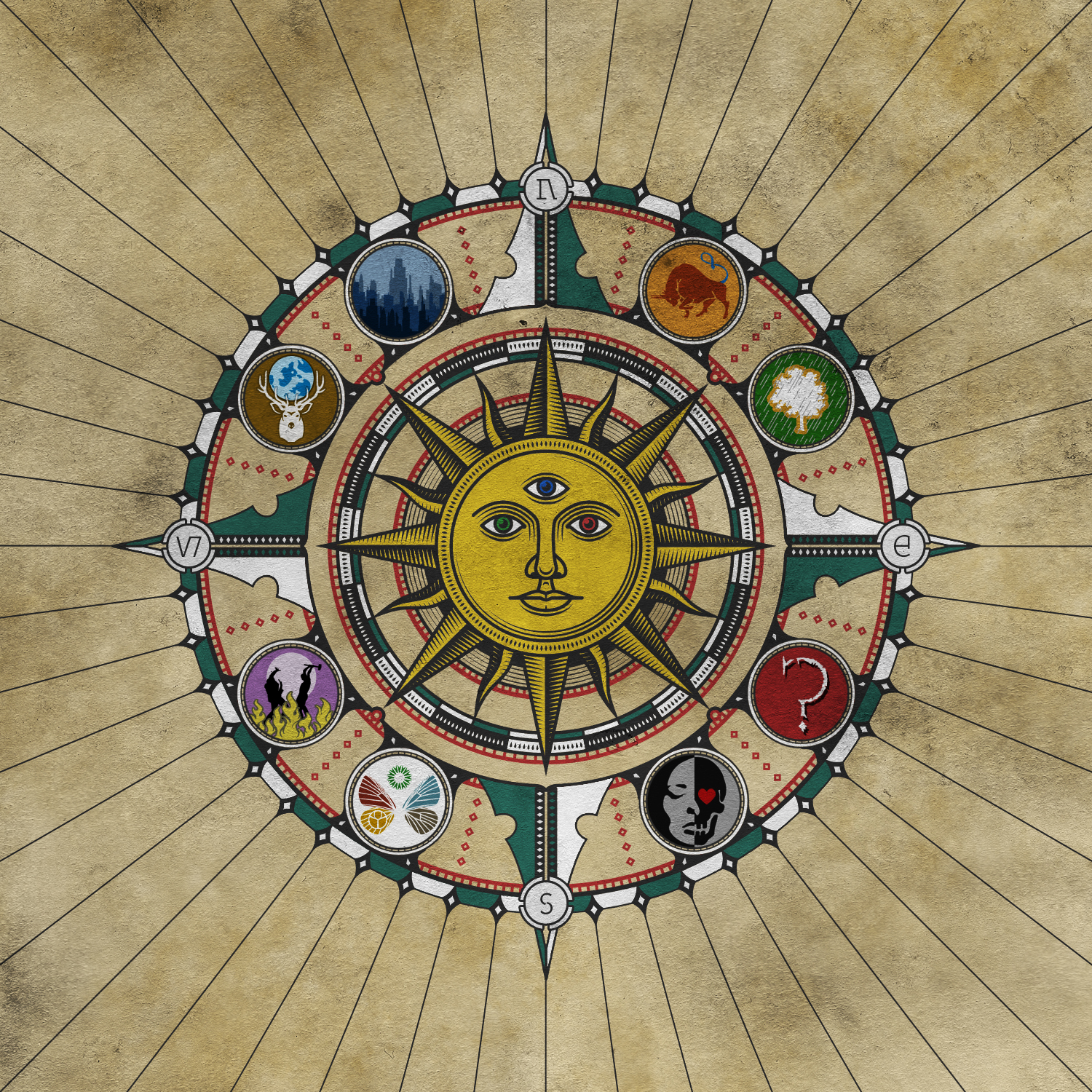
4 Directions, 4 Eagles of Wisdom

Our compass rose is from Daelin of Denmark, of the Cartographer's Guild

For the four directions the winds blow, four eagles rule.

From the North reigns the White Eagle. The element of wind and the season of winter are under his wing. He gives you hardiness, like the survival of all living things under the sharp cold. He gives fulfillment and wisdom that comes beyond age, as winter is the last season that is the full culmination of all seasons. Like the white snow, he gives you pure thoughts unadulterated by any wrong influence. 


From the East soars the Red Eagle, where the sun rises.  Just as the sun is born every day, the season of spring is a time of birth and renewal, and this season is represented by the Red Eagle. Things grow from the lush earth itself and this element is represented here. The Red Eagle gives us sight to see our own faults and understand others, with the utter simplicity of a newborn child. We also all can be immature or make many mistakes- just like the youngest of children. The Red Eagle helps to root or ground us.


The hot southern winds allow the Brown Eagle to fly, who rules over the equally hot summer season and the element of fire. The Brown Eagle lends us youth, strength and idealism. The fire of love burns and gives us passion and kindness. The Brown Eagle also uses the color of yellow...which is like the sun.


 Lastly is the Thunderbird, who rules autumn, the color black, and the element of water. Autumn is the final season where many things die. The Thunderbird brings final aging and growth, and with those self knowledge and realization in the face of all that is passing away. Also he calls the Great Storm that cleanses all filth with torrential rain. When we die (literally or in the figurative sense) we weather a storm and have impurities or unnecessary trappings washed away.

Remember these gifts the eagles, messengers to the Higher World, can give. Remember also the 7 Sacred Teachings of wisdom, love, respect, bravery, honesty, humility and truth.

Sunday, May 19, 2013

ARE WE UNIQUE?


"You are unique. You are one of a kind. No one in the whole world in all of history will ever be like you."  Many people have heard something along these lines at some point in their lives.

But how true is it? I'm about to argue, to an extent, that all of us are not as unique as we think.
Sounds negative, because we fear loss of identity. Without identity, who are we? We cease to exist in a sense..

For us all to be molecules making up the greater whole is not a bad thing, however, once you get your mind around it. With no identity, we are all one, there is no 'aloneness.' And there is no need to fight over details like creed, race, gender, sexual orientation, religious or spiritual beliefs, et al.

What I'm getting towards is that the material world and we as physical people do not matter as much in the Ultimate. In day to day life in the physical sense, yes, the world is real, the inhabitants are real...we need to eat and do all manners of other things to survive. Beyond that...we are vessels for the abstract, nothing more.

Say you hate someone. You don't hate them, you hate what they do. If you never met them in your life..just another stranger in the miasma of others wandering the street,  and then you crossed paths with them but they did you no wrong, you wouldn't hate them. Yet, same person right?

Same thing with love. If you have a dear lover, and they hit their head or become possessed or they start popping strong mind altering drugs and commit truly wicked acts, it's still them right? Maybe? Further, if your mind were to be wiped of all the better memories of when they weren't wicked...you would see them simply as a wicked stranger. The body..a shell. Remember the Matrix?  If you have seen this movie, any unsuspecting person could get taken over by an outside force, an agent, it wouldn't be 'them' anymore.


 Some of us are more prone to influence of one kind or another...this is analogous to saying certain clay jars are shaped differently and are more inclined to one purpose over another. Yet we all have the capacity to hold lifesaving water or sheer poison. We are all born empty, and I suppose we die empty. Full circle. I bet even Hitler was innocent and pure at least when he was first born. Mother Theresa could've been 'worked over' to the point where she was a vindictive monster. There are good gateways and bad gateways, we must be alert to their influence.

This is why it is beneficial to hate the 'sin and not the sinner' as the expression goes. Or know if we love someone, the light we find is not just in them but anywhere it is allowed to shine through in others.

Therefore, in the grand ultimate sense we are not unique. Getting into nit-picky details, sure I guess one could say we are unique, but if I plucked two peaches from a tree at the growers and shuffled them into a pile with hundreds of other peaches, it would be kind of hard to find those peaches again. So the final idea is we are far more similar to one another than different, and we all have potential to rot or thrive, just like the peaches. This is part of the balance of all things.


Faith

FAITH in a higher power- many have scoffed at the idea. They would presume that it consists of blind belief. I think of it more like faithfulness towards a spouse, it's rather like honoring the other and shunning outside corruptions that threaten to invade inward...

Where is the 'proof ' the higher power exists? It's Nature. You can't deny the trees are there, the wind, the ocean.  That's all the proof you need. Nature is God itself and/or an extension of God.
A common way of thinking of Nature is 'Mother Nature'. That is fine for some, but sometimes a mother is just thought of as a nagging or annoying person in the way. I like to think of Nature as a wife. Sure, a wife can nag too! But that's not the kind of wife I choose. And you can CHOOSE a wife, you can't choose your mother. I'm not saying mothers aren't important, but I find it easier to respect Nature as a wife.  Interestingly enough, the old word for farming or harmonizing with the land  is 'husbandry'. Here are some definitions as follows:

hus·band·ry 
n.
1.
a. The act or practice of cultivating crops and breeding and raising livestock; agriculture.
b. The application of scientific principles to agriculture, especially to animal breeding.
2. Careful management or conservation of resources; economy.

Of course, you could substitute the gender if you choose. It is all simple symbolism. Even if the Mother Earth image works for you, use it. Whatever creates a healthful relationship.
Notice too in the second definition CONSERVATION and ECONOMY are mentioned. Conservation brings to mind environmental preservation and never taking too much at once. For economy, 'eco' originally means 'home' in Greek. What is our true home? The planet itself. 'Nomy' is a suffix meaning system of rules, laws, or knowledge about a particular field. So economy is the 'way of the home', the Way of the Earth.

Yet do not think that following the 'Way' is by subduing or destroying the world in the process. True ecomony has very little to do with money. If 'health is wealth', the health of the Earth and our own health both are measuring sticks of how rich we are, not a nation's GDP or an amount in one's bank account. What you give, you receive. What you take, you must give back.